The potential for seaweed is expansive, with uses ranging from food to building supplies. This was a key takeaway from the inaugural Pacific Seaweed Summit in Campbell River.
North Island College and its Centre for Applied Research, Technology and Innovation (CARTI) co-hosted the May 6-8 event with the Wei Wai Kum First Nation, Heiltsuk Climate Action and Pacific Seaweed Industry Association.
“We're so pleased with the engagement and excitement that attendees have brought to this event in support of the seaweed sector,” said Naomi Tabata, CARTI director. “Hosting at our Campbell River campus allowed us to showcase the Seaweed Innovation Lab and the work of our incredible CARTI team.”
The summit brought together 150 participants, including researchers, industry professionals, Indigenous leaders, government representatives and community members from the Pacific region to consider opportunities for seaweed aquaculture. According to the World Bank, seaweed could employ up to 150 million people globally within 40 years, while Canada’s coastal regions are expected to play an international leadership role in the so-called “blue economy,” especially as B.C. is home to more than six-hundred species of native seaweed.
Chief Chris Roberts and Wei Wai Kum First Nation opened the conference on the Wednesday, saying the gathering offered a chance to show Campbell River as a sector hub for both seaweed restoration and cultivation.
“It was an opportunity to connect and network with other Indigenous participants and learn about their seaweed projects and our shared histories and stewardship of this important resource,” he said. “Wei Wai Kum and other Nations recognize that local interests must be reflected along the value-chain, and that this resource will be relied upon for our future generations."
The summit included keynote speakers Larry Johnson, president of the Nuu-chah-nulth Seafood Development Corporation, and Dune Lankard, the founder and president of Native Conservancy in Alaska, as well as panel discussions, workshops and a product showcase on the final morning.
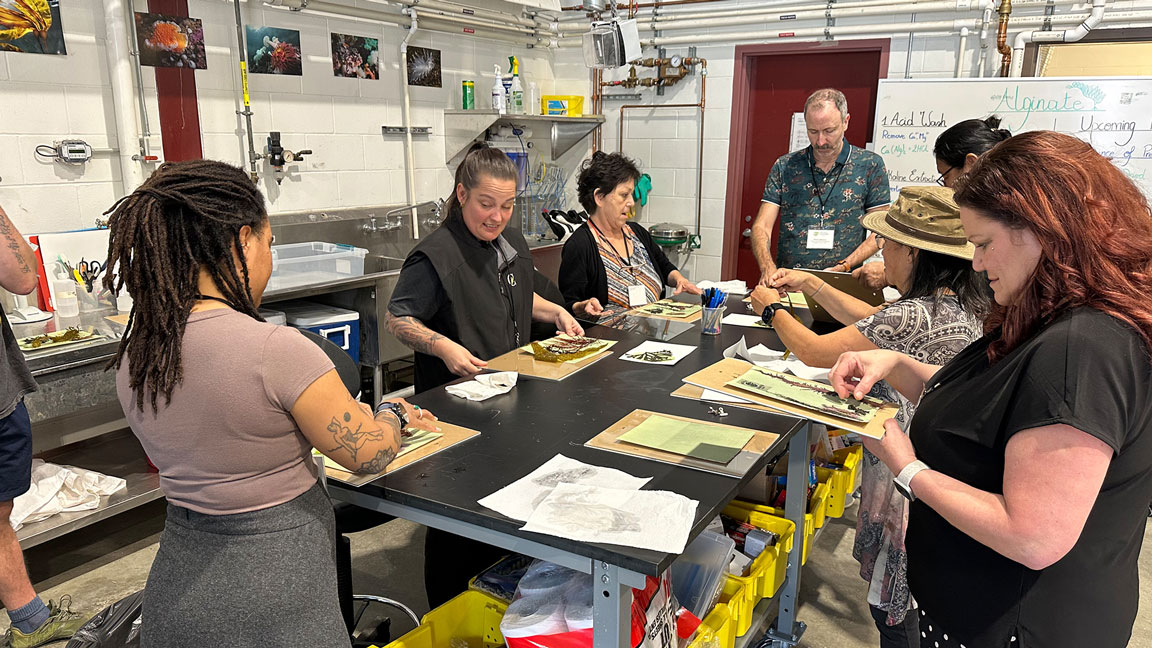
The opening event at the Big House of the Wei Wai Kum included a chance for everyone to take part in a ceremonial dance. Another highlight was the opportunity for participants to make seaweed art.
Both the Wei Wai Kum First Nation and Heiltsuk Climate Action have been members of the organizing committee. Desiree Lawson, executive director of Heiltsuk Climate Action, worked closely with CARTI on other projects, including inviting CARTI to a kelp symposium Heiltsuk Climate Action was hosting, so the collaboration was natural.
“I really enjoy working with NIC, and we have a really great relationship,” she said.
It was also important to have Indigenous organizers working on the summit.
“I think it was great to have that representation,” Lawson added.
Before the concluding remarks on Friday from members of the organizing committee, a product showcase allowed participants to have a look at some of the potential uses for seaweed, such as food products, fertilizers and carbon-storing foam that can be used for things like insulation.
Representatives from the companies or groups exhibiting at the showcase had a chance to provide a brief overview of what they have to offer, whether it was the products, research tools like bioreactors, other sector events and initiatives to protect ocean ecosystems.
There are plans to build on the momentum of the event, as Mark Smith, executive director from the Pacific Seaweed Industry Association, said, “We really work at putting all the pieces together. We’re also establishing what we’re calling the Canadian Seaweed Network.”