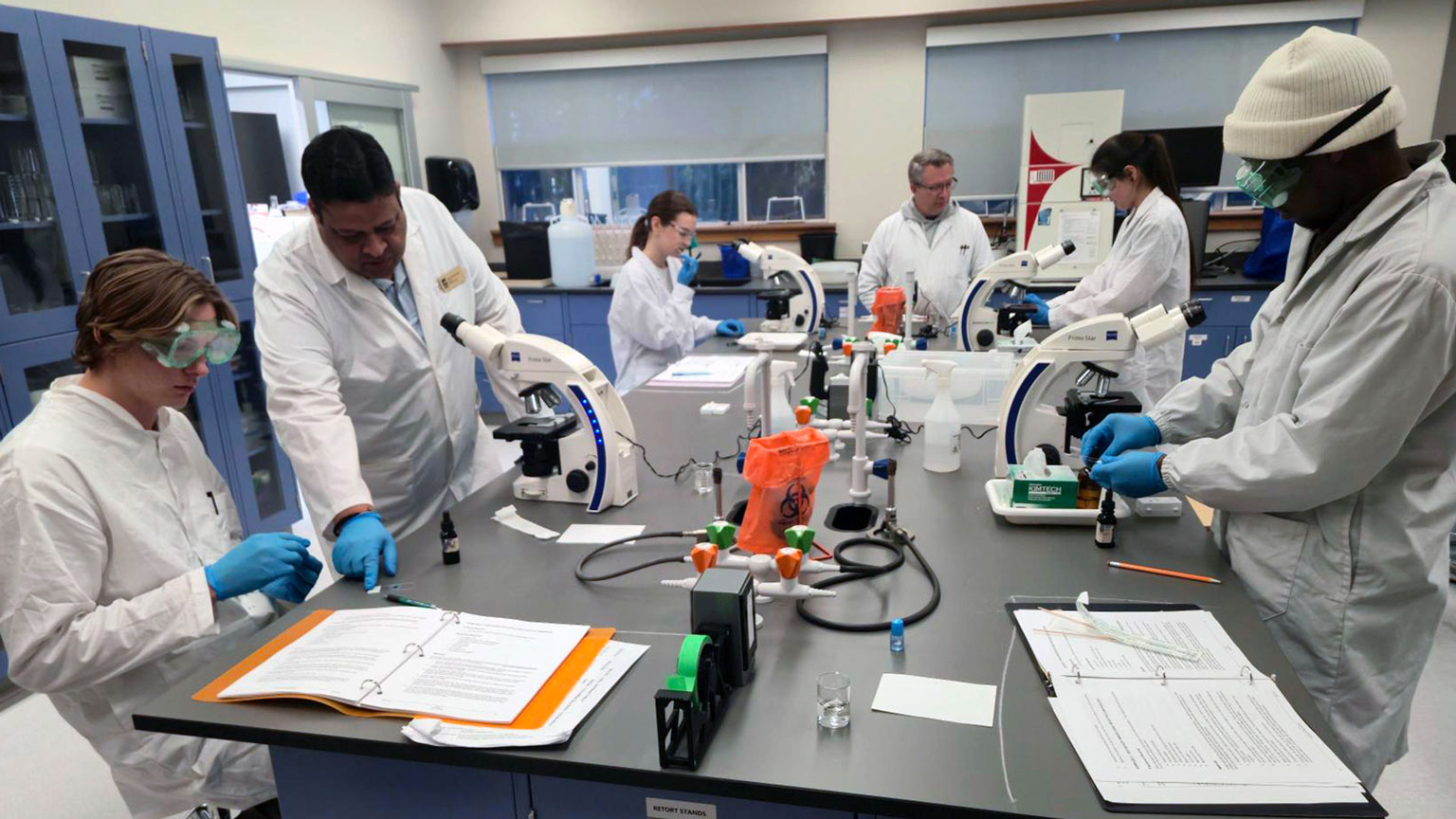
An NIC faculty member has been awarded a $10,000 grant from Prostate Cancer Foundation Canada (PCFC) to help design lab activities for students.
The funding will focus on educating third-year Island Pre-Health and Associate of Science students to become future health care professionals and to raise awareness about prostate cancer research. It will help with procuring samples, reagents and other essential supplies used for biomedical research and diagnostic techniques.
“This is a knowledge translation grant (KT),” said Rishi Somvanshi, Biology and Island Pre-Health Science faculty member. “With the PCFC KT grant, we will have tools and resources to plan and deliver labs, and that means a richer connection to the science they're studying.”
The grant will support a series of eight to nine labs for Biology 301 – General Biochemistry. It will give students the opportunity to work with advanced biomedical tools and research methods. However, as Somvanshi says, the theoretical and technical skills learned from the course can be applied across biology and health science programs, helping students to succeed in the next stages of their academic or professional journeys.
“Right now, we’re using prostate cancer as a focus, but the same lab model could easily be adapted to study other diseases like breast cancer,” he said.
The general biochemistry course Somvanshi teaches makes up part of NIC’s Island Pre-Health Science Advanced Diploma, which was launched in 2023 to prepare students for advanced health-related fields like medicine, dentistry, pharmacy and physiotherapy.
Knowledge translation often refers to the process of disseminating and applying knowledge from research. Often, this happens through research papers or presentations at conferences. While Somvanshi hopes to be making a presentation about the work in a pedagogy conference, in this case the KT takes the form of curriculum innovation by designing the lab to support a biology course at NIC. This model for developing lab activities focused on KT and health education can be used for other university transfer courses at NIC or by other post-secondary institutions.
The lab work will use prostate cancer to connect biochemistry, molecular biology and clinical diagnostics. It allows students to learn by using real-world tools and research methods, which will help them as they progress through programs to work in the health care sector. For example, they will be looking for markers in tissue samples or may use bioinformatics tools to look for protein structure and mutations.
“I think students realize the potential,” said Neil Cruickshank, NIC Dean of Faculty of Arts, Science & Management. “They realize it’s not an abstraction anymore.”
Somvanshi says PCFC was supportive of receiving an application from NIC, as colleges are not the usual applicants. He also applied for just over $7,900, but it granted the maximum $10,000 for the KT grant, which means greater flexibility for purchasing supplies for the work.
The PCFC award letter notes that the project will improve the level of care related to prostate cancer and serve in the development of the next generation of researchers in the field.
For NIC and the Centre for Applied Research, Technology and Innovation (CARTI), the project is an example of how applied research adds value to student learning and career development, while the equipment for curriculum development can benefit other research activity.