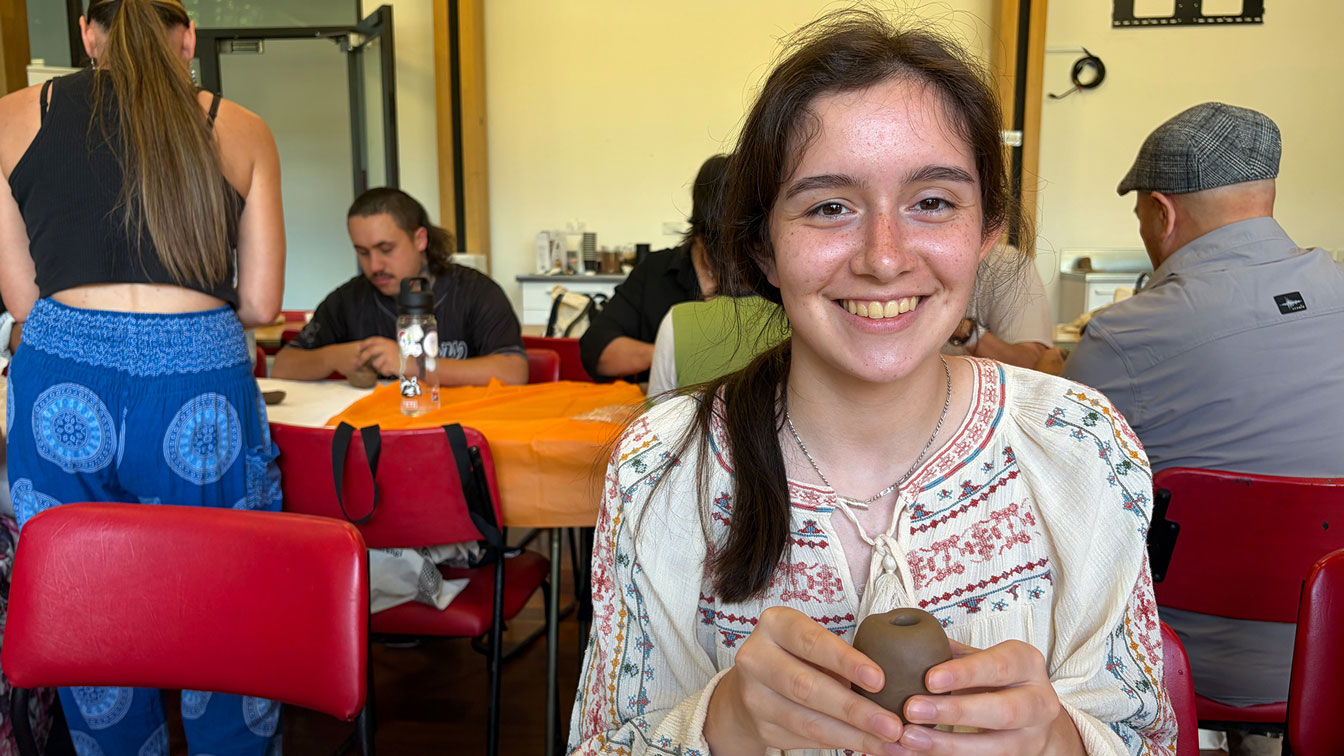
A North Island College student is one of a select few whose story is part of the latest annual report for the prestigious Queen Elizabeth Scholarships (QES).
The international education program, led by the Rideau Hall Foundation with Universities Canada, is a study abroad scholarship program. In recent years, colleges can also take part, with opportunities for students to get scholarships through NIC.
In its 10 years, QES has allowed 2,876 scholars to experience academic and cultural experiences around the world.
Only a few of these students, however, were chosen to be in the QES 10-year anniversary report, which includes highlights from its first decade. One of these was NIC participant Mahatta Price, who was excited to be included in the report. In it, she recounts her experiences in a full-page piece.
Price, who is a member of the K’ómoks First Nation, studied Indigenous Māori language and culture for two months from this February to April in New Zealand and did a homestay with a family to build on what she was learning.
“I was welcomed into the home of a Māori family where I was immersed in culture. I heard te reo Māori every day,” she said. “The granddaughter of the homestay family would stop by after school and on weekends. It was beautiful to see her embrace her culture so naturally. Her grandparents would always speak to her in te reo Māori, then she would translate to English so the other international student and I could understand.”
Price is planning to present what she learned to the Indigenous Education Council at NIC. She studied Kwak’wala last year at the college, is currently taking ʔayʔaǰuθəm through the University of Victoria and had also previously taken ʔayʔaǰuθəm courses through NIC.
Her QES experiences in Aotearoa—the Māori name for New Zealand—will also help her on a project to “awaken the sleeping ʔayʔaǰuθəm dialect” of the Kʼómoks First Nation. Ultimately, she hopes to teach Indigenous languages.
“I had such an amazing experience that I was thrilled to have the opportunity to share about my time in New Zealand,” she said. “What I learned during my time in Aotearoa was so impactful, seeing all the possibilities for our Indigenous language revitalization. I hope that my experience inspires others, especially other Indigenous students.”
Opportunities like the QES program are important, says Marisa Bennett, NIC Executive Director for Indigenous Education, because they allow Indigenous students to learn alongside other Indigenous peoples, see what is possible and bring that knowledge home to share.
“Mahatta’s experience in Aotearoa shows the power of Indigenous-to-Indigenous learning, especially in the work of language revitalization,” she said. “We are incredibly proud of her and hope her story encourages other Indigenous students to see themselves in opportunities like this.”
According to Romana Pasca, Executive Director, Strategic Business and International Development, this is an exceptional time for NIC students to consider scholarship opportunities to study abroad. With significant scholarship funding available through the Queen Elizabeth Scholarship and B.C. Scholarships over the next two years, she hopes more students will take advantage of these opportunities.
“We want students across our region to know that financial support for study abroad is available at NIC and that international experiences are more accessible than many people realize,” Pasca said. “We are especially committed to supporting students who may not have previously viewed study abroad as a realistic option, helping to make these opportunities more accessible and inclusive.”
For more information, check out NIC’s Global Engagement webpage.